
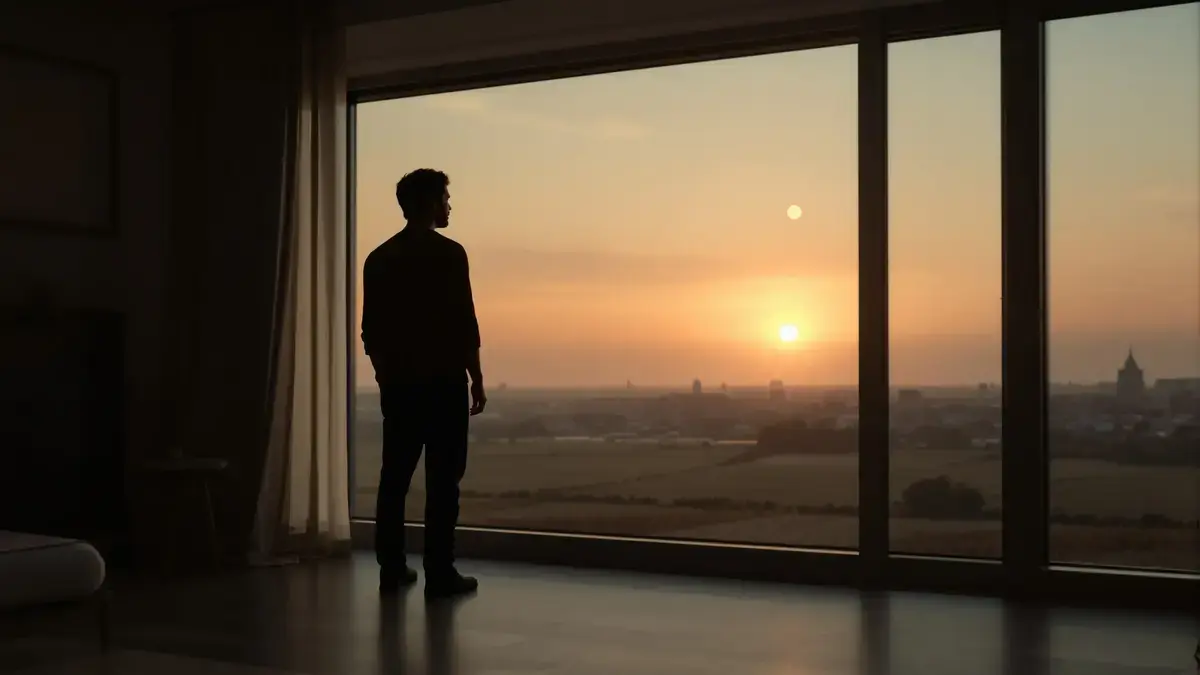

A morning when dawn arrives and the moon lingers—two lights at the horizon, each in their own fragile balance. From a window or the quiet outdoors, you might notice sunlight softening the eastern sky just as the full moon, wrapped in shadow, hovers low in the west. The moment is rare, one that seems, at first thought, to exist only in contradiction.
When the Impossible Appears Together
Most days, the sun and the moon keep their distance. Their schedules rarely overlap, especially during a lunar eclipse, when Earth falls exactly between the two. The expectation is clear: if one is up, the other has slipped away. Yet there comes a morning—this year, on March 3—when physics seems to step aside. For a breathless window, you can watch the sun rising in the east as the eclipsed moon sets in the west. The event is called a selenelion.
Atmospheric Refraction: Horizon’s Hidden Lens
Of course, the contradiction isn’t real. It’s a product of the Earth's atmosphere, which bends light and quietly redraws what we see. When the sun appears to touch the horizon, it’s really just below it. The atmosphere acts as a lens, lifting both sun and moon above their physical positions. For a couple of minutes, this lensing—known as atmospheric refraction—lets both celestial bodies hover in view, suspended on opposite horizons.
A Passing Interval, Defined by Place and Time
The selenelion only lasts one to three minutes, depending on where you are. Its brevity adds to the sense of strangeness—day and night holding hands before slipping apart. Along the Pacific Rim, regions closest to the eclipse’s total phase will notice the moon drowned in Earth's shadow. Areas within North America's eastern reaches see the moon set during totality, as morning brightens. Further west, the moon starts to escape the shadow before disappearing below the skyline.
Shadows and Subtlety at the Horizon
The appearance changes subtly with location. In some places, a dim reddish moon clings to the horizon, washed out by growing daylight and the ever-present haze. Western and Mountain Time Zone observers sometimes see only a partial eclipse—just a “bite” missing. For some, especially near city edges or rural fields, the atmosphere’s haze can hide the eclipsed moon minutes before sunrise. Spotting both sun and moon demands open horizons and careful attention.
Celestial Rules and Real Experience
The event underlines how the world’s geometry and daily perception sometimes part ways. In theory, a selenelion cannot happen. In practice, it is made possible by the subtle lensing of air close to the ground—a reminder that what we see is shaped not just by the cosmos, but by the thin, bending veil we live beneath. For that brief overlap, the sky crafts a fleeting illusion, where observation and reality blur.
A Short-lived Contradiction, Offered by the Atmosphere
Such moments illustrate the atmosphere’s constant yet often unnoticed influence. A selenelion is not just a curiosity: it's a quiet collision between physical law and lived experience. On March 3, for a few, the horizon will hold both night’s end and day’s beginning, showing that between calculation and vision, there is a space reserved for surprise.
