
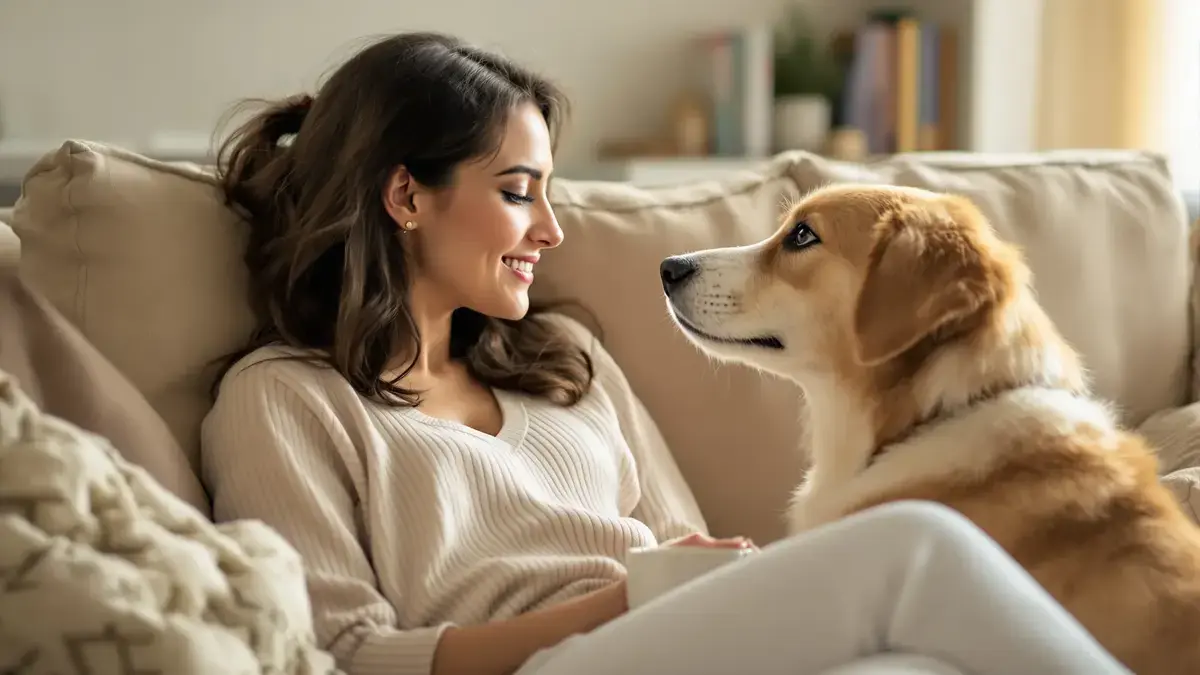

Some mornings, the quiet moment when a dog settles at your feet feels oddly significant. His gaze lingers on your face, soft and steady, hinting at something deeper than the usual routine of food and walks. Behind that familiar glance sits a complex story of connection, one shaped by millennia. The real nature of this bond is more intricate—and perhaps more extraordinary—than many realize.
Attachment Built in the Gaze
In a living room or on a walk, the sight is familiar: a dog locking eyes with its human companion. This is not mere curiosity or the anticipation of a treat. When a dog gazes into a person’s eyes, both experience a surge in oxytocin—often called the “love hormone.” In that instant, a feedback loop forms, with the dog’s gaze prompting oxytocin in the human, in turn reinforcing the dog to hold the gaze just a little longer.
A Cycle Unique to Dogs
Dogs are not alone in their longing for attachment, but the mechanism they share with people is rare. Wolves, even when raised by humans, avoid prolonged eye contact and do not participate in this oxytocin-driven loop. This subtle biological choreography is the result of thousands of years of shared history, shaped through domestication. It doesn’t emerge in the wild or simply because of close proximity.
Not a Simple Mirror of Parental Love
While the process echoes early-childhood bonding—such as between a mother and her child—the connection between dog and human isn’t an imitation of parental love. Experts warn against blending these meanings. The neural mechanisms show overlap, but what passes between dogs and humans each day is a distinct form of attachment, shaped by its own evolutionary logic.
Attachment on Display
Everyday acts—like a dog curling up beside you, bringing a favorite toy, or yawning when you do—signal trust and empathy. Brain scans reveal that a dog’s reward center, the caudate nucleus, responds not only to the smell of an owner, but also to their voice and praise. Sometimes, the response is stronger than to food. These moments are more than habit; they are physical evidence of emotional synchrony.
A Bond Engineered by Evolution
Unlike relationships simply based on reward or survival, the dog-human bond is reinforced by both partners. Through the centuries, dogs have adapted to “read” their human companions, tapping into deep-seated biological systems intended for connection. This relationship is not about tolerance or convenience—it is about coadaptation, a shared circuit of emotion and reward, grounded in biology.
Beyond Simple Affection
Understanding this bond means recognizing its shape: mutual, chemical, and embedded in the brain. It isn’t just an exchange, nor does it copy the bond between parent and child. Instead, it is a unique pathway—a reflection of countless quiet exchanges, long before words or commands. The science is clear, but the feeling is found in moments as ordinary as a dog’s gaze on a slow afternoon.
In the end, the attachment between dogs and humans stands as a quietly powerful product of coevolution, anchored not in imitation, but in shared neurochemistry and emotional resonance. It is a relationship with its own purpose and character—visible in every gentle look exchanged.
