
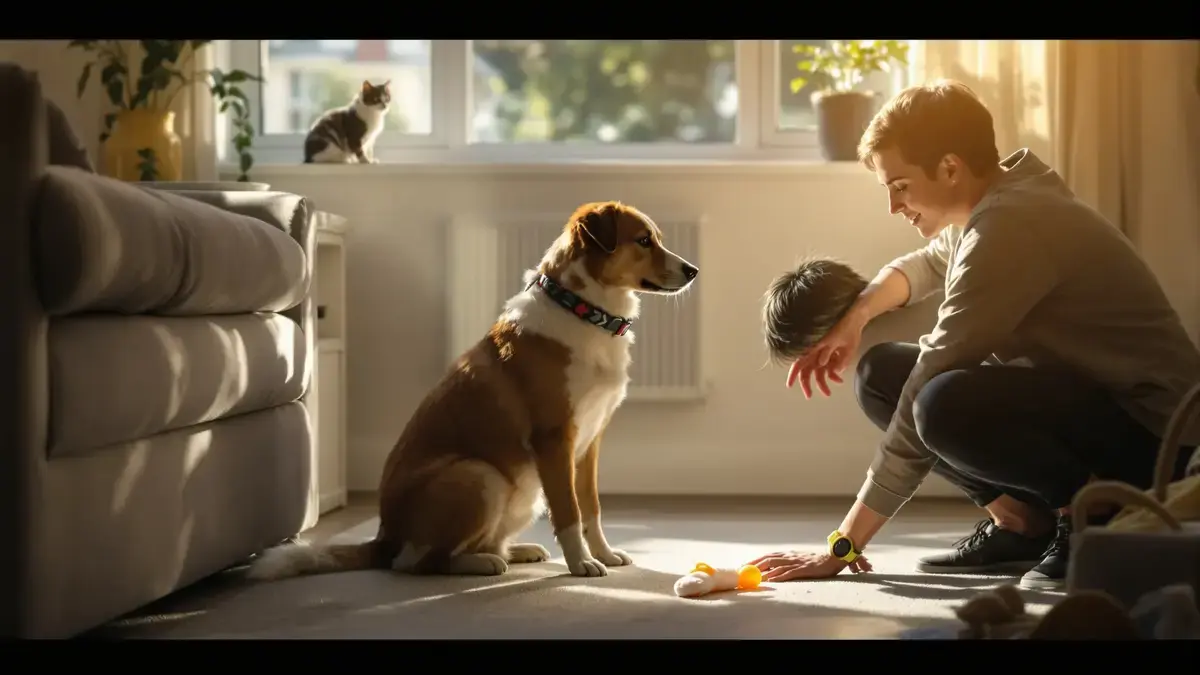

Sunlight drifts across the living room, highlighting a plastic toy forgotten in the corner. Nearby, a dog sits alert, ears pricked as its human scans the floor for something hidden. For a moment, the world narrows to a gentle exchange—one glancing at the other, both aware of a task at hand. What feels like an ordinary morning reveals a quiet thread linking young children and their canine companions through an impulse to help.
Unexpected moments of cooperation
Dogs often surprise with their timing. A sock disappears under furniture, a spoon falls from the counter, and before the request is spoken, a furry friend is already on the move. This spontaneous response is not just learned behavior. Instead, studies observe that dogs, like small children, seem naturally drawn to lend a hand—or paw—when they sense someone searching.
The signature cues of helping
Observers notice certain patterns as dogs and toddlers guide people to what’s lost. There’s an unmistakable back-and-forth gaze, shuttling focus between human and object. Sometimes, a dog pads closer or noses at the spot, echoing the same gestures a toddler might use to direct attention. The action is quick, almost automatic, as if cooperation itself is as familiar as a walk in the park.
Prosocial instincts, not just tricks
These actions stand apart from trained commands or clever routines. Prosocial behavior—where one acts to assist another without seeking a reward—appears early in toddlers and emerges unprompted in dogs. Even when the object in question holds no interest or value for the helper, the impulse remains. Over seventy-five percent of dogs and toddlers spontaneously try to help, untrained and unrewarded, driven only by social motivation.
The independent mind of a cat
Contrast arrives with a cat perched on a windowsill. Feline companions rarely get involved, unless something is in it for them—a tempting toy, perhaps, or a favorite treat. Independence shapes their choices. Evolutionarily solitary, cats choose engagement on their terms, a pattern reflecting confidence in self-sufficiency rather than absence of care.
Evolution’s subtle legacy
Dogs have shared homes and routines with humans for centuries. These roots have cultivated a deep-seated tendency toward cooperation. By comparison, cats joined people not for community but for opportunity—protection, food, warmth. The divergence shows: dogs help because it’s woven into their social bonds, while cats join in when the payoff matters to them.
Seen in small gestures
At home, these differences play out in gentle, everyday exchanges. A dog nudges a ball closer, waiting as a child giggles. A toddler fetches a misplaced shoe, offering it without expectation. In contrast, a cat may observe, poised to join only when curiosity or self-interest stirs.
Two paths, one shared world
In these mirrored behaviors, the evolutionary story of human-animal connection is quietly told. Dogs and toddlers reveal a readiness to help for its own sake. Cats, steady in their autonomy, remind us that not all forms of care look the same. Each approach adds something distinct to the fabric of our shared days, shaped by the long and varied histories of species and home.
