
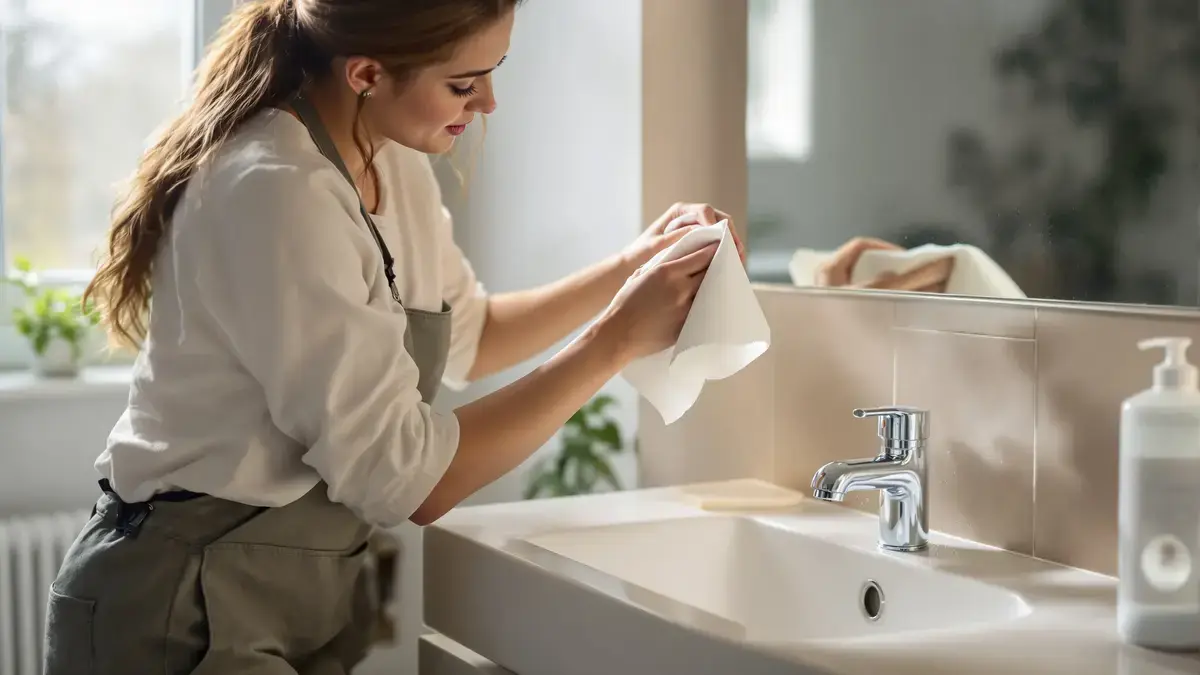

Most mornings begin with a fogged bathroom mirror and streaks of limescale along the faucet—tiny reminders of the rituals we repeat without a second thought. For many, a simple wipe never seems enough, and pricey products promise shine but rarely transform the routine. Yet, tucked away in kitchen cupboards is a simple pairing that quietly addresses a bathroom nuisance often ignored: stubborn build-up that dulls, stains, and absorbs everyday odors.
Everyday Tools Reimagined
A roll of toilet paper nearby is as ordinary as the hum of pipes after a morning shower. But when paired with vinegar, its purpose expands quietly. By soaking a few squares with this sharp-smelling liquid, what was once reserved for comfort becomes a surprisingly effective tool in the fight against grime.
This duo works on faucets, mirrors, or even the tiled ledge behind the sink. Instead of reaching for bleach or harsh sprays, the method is straightforward: press the dampened paper onto the area needing attention, let it rest long enough to allow the vinegar to work. In minutes, tough limescale and soap residue soften, while the paper absorbs lingering moisture and trapped smells.
The Science Beneath the Surface
At its core, vinegar is a blend of water and acetic acid, effective at attacking mineral build-up. Used at an 8% concentration, its mild acidity dissolves calcified rings on taps and polishes streaked glass to a gentle gleam. Because it’s natural and biodegradable, vinegar quietly replaces stronger, chemical-laden cleaners in daily routines.
Toilet paper, with its compact texture and high absorbency, serves as both applicator and wipe. Once the vinegar has loosened grit or scale, the paper can be discarded—taking grime with it. This approach keeps surfaces bright and helps reduce the chemical load in household air and water.
Cautions That Make Sense
Not every surface welcomes vinegar’s strength. It can etch marble, strip varnish, and weaken rubber seals. That’s why a spot test is wise: dab a hidden area before treating larger stains. And never combine vinegar with bleach—their chemical reaction releases dangerous fumes.
Still, in most ceramic, glass, or chrome-lined spaces, the technique saves time and keeps things gentle. Bathroom routines feel less like chores and more discreetly effective, with fresh, streak-free finishes left behind.
The Utility Behind the Familiar
The innovation lies in the simplicity. These items—often overlooked—become a modular cleaning set, adaptable and minimal. The process leaves no artificial fragrance or sticky residue; just a quiet, not-quite-clinical freshness.
Habitual maintenance becomes easier when the solution is always at hand: a bottle of vinegar, a roll of toilet paper, and a few spare minutes. Odors soften, watermarks fade, and repeated tasks pass without fuss.
Looking Past the Obvious
What began as a small upgrade to personal comfort now finds new uses, reshaping household maintenance. This pairing reintroduces the idea that the simplest tools, with slight alterations, can quietly solve problems we no longer notice. Day after day, it’s the plain combinations—vinegar and toilet paper—that steadily keep the bathroom clearer and more welcoming.
