

Dawn spills into the kitchen as Tamzin Outhwaite ties her sneakers, the gentle clatter of breakfast and schoolbags in the background. Each week, after waving her children off, she carves out a slice of quiet for herself—a time neither hurried nor grand, but steady. At 55, Tamzin’s approach to fitness weaves seamlessly into her changing routine, shaped by the shifting rhythms of perimenopause. The everyday details, both ordinary and quietly meaningful, reveal how strength and self-care coexist.
Stability Over Speed
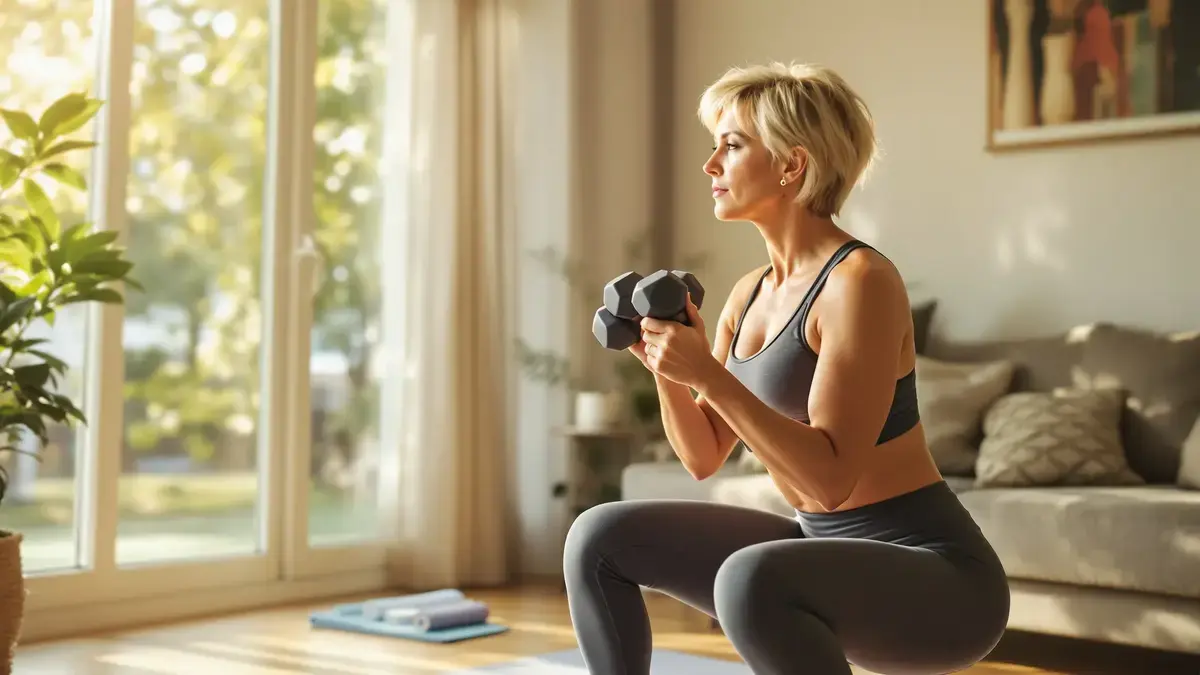
The idea of jumping, fast bursts, and high intensity once animated many fitness classes. For Tamzin, those days have shifted into something slower—still deliberate, but less jarring. Now, low-impact strength training sits at the core of her exercise routine. Sessions unfold in measured movements: squats held at the bottom with a lingering pulse, or muscles braced tight in a steady isometric hold. No leaps, just control. This style didn’t happen overnight; it’s a careful adaptation, designed to support muscle and stability as her body changes.
Structure That Breathes
Each workout traces a familiar arc—40 minutes split into warm up, main session, and cool down. Some mornings, Tamzin faces a set of supersets: 45 seconds of effort, 15 seconds to reset, repeat. On other days, the pattern changes, moving through repetitions that climb the ladder as fatigue creeps in. There’s rhythm, but also variety, keeping both muscles and mind engaged. The exercises—lunges, single-arm rows, shoulder presses—are practical, rooted in real-world movements. The tempo remains slow, each lift guided by precision, not adrenaline.
Form First, Pressure Last
Numbers matter less than form. Tamzin chooses weights that challenge but do not distort her technique. Ten strong reps carry more meaning than twenty rushed ones. Whenever familiar exercises become easy, she quietly adds a kilogram or two—no fuss, no spectacle. If a session is missed, there’s no guilt. The next day is simply a return to routine, not a punishment. It’s the kind of consistency only possible when discipline is untangled from perfectionism.
Fitness Within Everyday Life
The drive to walk 10,000 steps a day runs parallel to these workouts: brisk strides along city pavements, steps climbing between errands and auditions. Meditation slips in during longer pockets of time, as Tamzin wraps herself in the warmth of a sauna blanket. These moments—quiet, restorative—gather slowly, restoring clarity lost in the flow of demands. Occasionally, she disappears on a solo retreat or guides others in free wellness workshops spanning yoga, nutrition, and mindfulness. Here, wellbeing broadens beyond the gym, touching daily rituals and community spaces alike.
A Balanced View of Food and Energy
Eating, for Tamzin, isn’t marked by anxiety. Meals remain a source of pleasure. She jokes with friends about being ‘Tamzin hungry’—its own cheerful category. Through structured learning, she has become gently aware of calories and how energy shapes her day, but there’s no relentless tracking. The goal isn’t leanness or restriction—it’s nourishment that matches her lifestyle and the demands of acting, parenting, and movement.
A Quiet Evolution
Tamzin’s journey through perimenopause doesn’t unfold with dramatic statements or radical change. Instead, it’s carried in small adaptations: a slower squat, a measured breath, steps counted on city streets. Fitness here is less a stage and more a foundation—a way to find balance and mental peace amid shifting routines. By listening to her body’s needs, Tamzin makes wellness a quiet, enduring companion.
